Key Takeaways
- Shingle granules are sand like particles from asphalt shingles that wash into gutters over time and cause clogs when they accumulate.
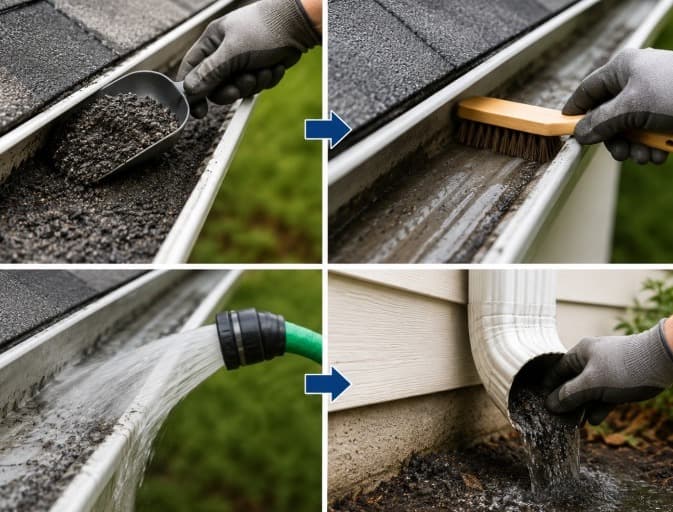
- The correct cleaning sequence is: dry scoop first, brush the channel, flush with a garden hose, then clear the downspout.
- Clean gutters at least twice a year: spring and late autumn and always after major storms.
- Large, sudden granule loss – especially on a roof under 15 years old – is a sign of potential roof damage and warrants a professional inspection.
- Always use gloves, safety glasses, and a secure ladder, and never work alone at height.
What Are Shingle Granules and Why Do They End Up in Your Gutters?
Shingle granules are small, crushed stone particles embedded into the surface of asphalt roofing shingles. They protect the shingle’s asphalt layer from ultraviolet (UV) light and rain impact. Without them, asphalt shingles would crack and deteriorate in a fraction of their expected lifespan.
Granules shed naturally over the life of a roof. Rain washes them off the shingles, they slide down the roof slope, and gravity drops them straight into your gutters. A new roof sheds more granules in its first year than at any other point — this is normal and does not signal damage.
The problem is not the shedding itself. The problem is what happens when granules sit in your gutters: they mix with leaves and dirt to form a dense, heavy paste that blocks water flow. Left long enough, that blockage forces water over the gutter edge and down your home’s foundation walls.
What You Need Before You Start Cleaning
Gather these items before climbing the ladder. Having everything on hand means you will not need to climb down mid-job.
- A sturdy extension ladder rated for your weight plus tools
- Work gloves (granules have sharp edges)
- Safety glasses
- A garden trowel or gutter scoop
- A stiff-bristled hand brush
- A garden hose with a spray nozzle
- A 5-gallon bucket with a hook to hang from the ladder
- A plastic tarp or drop cloth for the ground below
One person working alone on a ladder is a safety risk. Ask someone to stay nearby and hold the ladder base, especially on uneven ground.
Read Also: What Happens If You Don’t Use Underlayment on a Roof?
How to Clean Shingle Granules from Gutters: Step by Step
Cleaning shingle granules from gutters takes most homeowners between one and three hours for a standard single-story home. Work in dry weather, wet granules are heavier and the ladder is less stable on damp ground.
Step 1: Set Up the Ladder Safely
Place the ladder on flat, solid ground at a 75-degree angle that means the base sits roughly one foot away from the house for every four feet of ladder height.
Lock the ladder’s spreader braces fully open if using a stepladder. For a single-story roof, an extension ladder extended at least three rungs above the gutter line gives you a stable working position.
Never lean sideways off the ladder to reach further along the gutter. Move the ladder every 4 to 6 feet instead.
Step 2: Dry-Scoop the Bulk of the Granules
Before using water, remove as much dry material as possible by hand.
Use the garden trowel or gutter scoop to lift the granule-and-debris mix out of the gutter channel and drop it into your hanging bucket. Work from one end of the gutter toward the downspout.
Dry removal first is worth the extra time; it prevents you from flushing a heavy granule slurry into and through the downspout, which can cause a partial blockage lower down in the drain system.
Step 3: Brush the Gutter Channel Clean
After scooping, run the stiff-bristled brush along the gutter bottom to dislodge granules stuck in corners and seams. Pay attention to the area directly above the downspout opening – granules pack tightly there and the brush breaks them loose before you flush with water.
Brush debris into a pile, then scoop it into the bucket. You do not need to be perfectly clean at this stage – the hose handles the fine particles in the next step.
Step 4: Flush the Gutters with a Garden Hose
Start flushing from the far end of the gutter – the end furthest from the downspout. Direct the hose spray along the gutter bottom toward the downspout, working the remaining granule dust and grit toward the drain opening.
Watch the downspout while you flush. Water should flow out freely at the bottom within a few seconds. If water backs up or trickles out slowly, there is a partial blockage in the downspout.
Step 5: Clear a Blocked Downspout
If the downspout is blocked, insert the hose nozzle directly into the top of the downspout and turn the water pressure to full. Hold the nozzle in place for 30 seconds. Most granule blockages break up with direct water pressure.
If water pressure alone does not clear it, use a plumber’s snake; a flexible metal cable available at any hardware store to manually break up the clog. Feed it into the top of the downspout and rotate it as you push it down.
Step 6: Do a Final Rinse and Check for Leaks
Once the downspout runs freely, do one final flush from end to end. While the water is running, watch the gutter joints and end caps for any drips or leaks. Granule buildup sometimes masks small cracks or failed sealant; water makes them visible immediately.
If you spot a leak at a joint, dry the area after cleaning and reseal it with gutter sealant from any hardware store.
Step 7: Clean Up the Ground Below
Spread the tarp before you start if you want easy cleanup. Granules that fall to the ground during scooping are sharp enough to damage bare feet and can scratch wood decking if left in place.
Fold the tarp and dump its contents in a trash bag. Do not sweep granules into garden beds; the crushed stone is inert but adds no benefit to soil.
How Often You Should Clean Shingle Granules from Gutters
Clean your gutters at least twice a year: once in late spring after tree pollen and seed pods fall, and once in late autumn after leaves drop. Homes surrounded by trees may need cleaning three to four times a year.
After any major storm with high winds, do a visual check from the ground. If you can see debris piled in the gutter channel from ground level, it is worth a cleaning before the next rain event.
When Granule Loss is a Warning Sign, Not Normal Wear
Most granule shedding is routine. However, certain patterns point to a roof that needs professional attention, not just a gutter cleaning.
Watch for these signs:
- Bare patches on shingles: If you can see dark, exposed asphalt on shingles from the ground, those areas have lost their granule coating and are no longer UV-protected.
- A large volume of granules after one storm: Finding a cup or more of granules in a single downspout after one rain event; especially if the roof is less than 15 years old – points to impact damage or manufacturing defects.
- Granules concentrated in one spot: If granules appear in only one section of gutter rather than spread evenly across all gutters, the shingles above that spot may be failing locally.
- Granules in your yard, not just gutters: Granules landing several feet away from the house suggest wind is stripping them off the roof surface rather than rain washing them off gradually.
If any of these apply, call a licensed roofing contractor for an inspection before doing further gutter work. Walking on a roof with failing shingles can accelerate the damage.
Mistakes to Avoid When Cleaning Granule-Filled Gutters
- Flushing before dry-scooping: Sending a thick granule slurry through the downspout is the fastest way to create a blockage lower in the drainage pipe. Always remove bulk material by hand first.
- Using a pressure washer on gutters: A pressure washer can dent aluminum gutters, blast sealant out of joints, and force water behind the fascia board. A standard garden hose with a spray nozzle is enough force for granule removal.
- Ignoring the downspout: Many homeowners clean the gutter channel but skip checking the downspout. Granules that reach the downspout settle at bends in the pipe. Flush the downspout every time you clean the gutters.
- Working on a wet roof or ladder: Granules are small and round – on a wet surface, they act like ball bearings underfoot. Stay off the roof and ladder in wet conditions.
- Cleaning alone: A fall from a single-story roof or ladder is enough to cause serious injury. Always have someone with you when working at height.
Is Your Roof Ready for Next Season?
Cleaning shingle granules from gutters is a two-hour job that most homeowners skip until water starts spilling over the edge. By then, the damage to fascia boards and foundations has already started.
Do it before the next heavy rain season. Scoop first, flush second, check the downspout last. If you find more granules than expected or bare patches on the shingles above; make the call to a roofer before the season turns. A gutter cleaning that doubles as an early roof inspection is the cheapest maintenance decision you can make.