Seamless Gutters are the better pick for most homes, but Regular Gutters still make sense in a few cases. The choice comes down to budget, how long you plan to stay, and whether you want to install the gutters yourself.
Gutters look like a small purchase until one leaks. A failed joint can send water behind the fascia, down the siding, and into the foundation. That is why the gutter type you pick matters more than most people expect.
The two types differ in cost, leak risk, lifespan, maintenance, and who can install them. Each of those differences is covered below, along with a simple way to match a gutter type to your home.
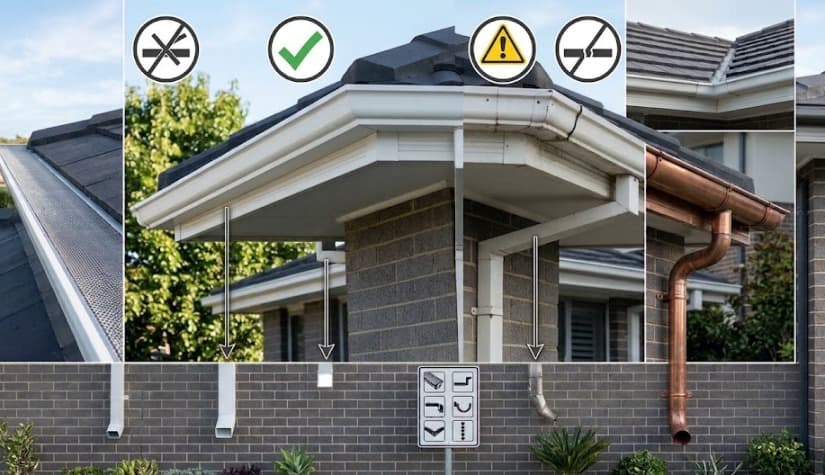
What is the Difference Between Seamless Gutters and Regular Gutters?
The difference is how the gutter is built. Seamless Gutters are rolled from a single metal coil at your home, so each run is one continuous piece. Sectional Gutters, the regular type, are precut sections joined with connectors and sealant. This one difference drives most of the gap in cost, leaks, and lifespan.
Sectional gutters usually come in 5, 10, or 15 foot pieces. You can buy them at a hardware store and cut them to fit with a saw.
Seamless gutters need a contractor. The installer brings a roll forming machine to your home and forms each length to your exact measurements.
| Feature | Seamless Gutters | Sectional Gutters |
|---|---|---|
| How they are made | Rolled from metal coil on site | Precut sections joined on site |
| Joints | Corners and downspouts only | Every section joint, plus corners and downspouts |
| Typical labor cost per foot | $3 to $10 | $2 to $6 |
| Typical lifespan | 20 years or more, depending on metal | 10 to 15 years |
| Installation | Professional only | DIY is possible |
How Many Seams and Joints Does Each Gutter Type Have?
A seamless run has joints only at corners and downspout outlets. A sectional run adds a joint every time two pieces meet.
A 150 foot run built from 10 foot pieces has 14 joints along its length, before you count corners and outlets.
Joints matter because they are where gutters usually fail. Water seeps through them, and leaves and twigs catch on them. Sectional gutters can also pull apart at the seams during severe storms.
Sealant does not fix this for good. Even well caulked seams break down over the years, so sectional gutters need resealing as they age.
Think of a garden hose. A hose with five couplings has five places to drip, and a single piece of hose has none along its length. Gutters work the same way.
How Much Do Seamless Gutters Cost Compared to Sectional Gutters?
Seamless gutters cost more than sectional gutters. Labor typically runs $3 to $10 per linear foot for seamless and $2 to $6 for sectional. The extra cost pays for custom fabrication on site, since you cannot buy seamless gutters off the shelf.
Here is what that means on a 150 foot job. Seamless labor comes to $450 to $1,500 and sectional labor comes to $300 to $900. These totals are calculated from the per foot ranges and leave out materials.
For a whole house, most homeowners spend somewhere between $625 and $1,713 on a standard installation. Larger homes, premium metals, and complex rooflines can push a seamless project to $5,000 or more.
Material changes the price more than gutter type does. Typical ranges per linear foot look like this:
| Material | Cost per linear foot |
|---|---|
| Vinyl | $3 to $6 |
| Aluminum | $4 to $14 |
| Galvanized steel | $6 to $14 |
| Stainless steel | $9 to $20 |
| Zinc | $10 to $29 |
| Copper | $25 to $40 |
Extra costs add up. Each additional story adds about $1 to $3 per linear foot, and removing old gutters adds roughly $0.65 to $0.85 per foot.
Prices vary by region, so get at least three written estimates from licensed and insured installers.
How Long Do Seamless and Sectional Gutters Last?
Sectional gutters often last 10 to 15 years. Seamless gutters commonly last 20 years or more with proper care, and copper gutters can last 50 years or longer. Some sources claim seamless gutters reach 100 years, but treat that figure with caution.
Material affects lifespan as much as seam count. Stainless steel can last the life of the home when it is maintained. Vinyl needs replacing sooner than metal and can crack where winters bring repeated freezing and thawing.
A seamless aluminum gutter will usually outlast a sectional vinyl gutter for two reasons: fewer seams and a more durable material.
Cleaning habits matter too. A gutter packed with wet leaves holds weight and moisture, which speeds up sagging and rust on either type.
Can You Install Seamless or Sectional Gutters Yourself?
You can install sectional gutters yourself, but you cannot install seamless gutters yourself. Seamless gutters are made by a professional with a roll forming machine, so homeowners cannot buy them for DIY work.
Sectional DIY is still real work. You need to measure each run, plan the downspouts, cut sections, attach hangers, and seal every joint. You also need to check the fascia, the board along the roof edge, for rot before you hang anything.
A professional can finish an average house in 7 to 10 hours. A first time installer needs much longer, and a gutter hung at the wrong angle or fastened badly can do more harm than good.
Ladder work also carries a real risk of injury. If you go the DIY route, budget extra time for the first run. Any mistake in pitch shows up the first time it rains.
What Maintenance Does Each Gutter Type Need?
Both types need cleaning at least twice a year, and more often under heavy tree cover. Seamless gutters collect less debris because they have fewer joints for leaves to catch on. Debris still builds up near downspouts and corners.
Sectional gutters need extra checks. Inspect each seam for sealant that has cracked or pulled away, and replace damaged sections as needed.
Professional gutter cleaning usually costs $125 to $225 per visit. Gutter guards cost about $7 to $12 per linear foot installed. Guards reduce debris and cut down how often you need to clean.
Which Gutter Type Fits Your Situation?
Seamless gutters fit most homeowners who plan to stay put. Sectional gutters fit specific cases: tight budgets, DIY projects, and small outbuildings. Use this table to match your situation to a gutter type.
| Your situation | Better choice | Why |
|---|---|---|
| You plan to stay in the home for ten years or more | Seamless | Fewer repairs offset the higher upfront cost |
| You have heavy tree cover | Seamless with gutter guards | Fewer joints catch debris, and guards cut cleaning |
| You want to install them yourself | Sectional | Seamless needs a professional roll forming machine |
| You have a tight budget | Sectional aluminum | Labor and materials cost less up front |
| Your winters have freeze thaw cycles | Metal of either type | Vinyl can crack in freeze thaw cycles |
| You are covering a shed or small garage | Sectional | The short runs mean few joints |
Does Installation Quality Matter More Than Gutter Type?
Installation quality matters as much as gutter type. A badly hung seamless gutter can fail faster than a well hung sectional one. Proper pitch and support spacing have a major effect on long term performance.
Experienced installers follow two rules of thumb. Gutters should slope about 1/4 inch for every 10 feet, and brackets should sit 18 to 24 inches apart. Downspouts also need to be sized for your roof runoff, or the gutters overflow even when the install is correct.
Ask each installer these questions before you sign:
- What is your warranty on materials and labor?
- How long will the installation take?
- Which materials do you recommend for my home, and why?
- Do you also install gutter guards?
Conclusion
Seamless gutters cost more to install, at $3 to $10 per foot in labor versus $2 to $6 for sectional. In return they have joints only at corners and downspouts, and most gutter failures happen at joints.
Choose seamless if you plan to stay in your home for years, have trees near the roof, or want fewer repairs. Choose sectional if you are on a tight budget, want to install the gutters yourself, or are covering a small outbuilding.
Whichever you pick, get three written estimates, check that the installer is licensed and insured, and confirm the pitch and bracket spacing before work starts.