Half Round and K Style are the two gutter profiles most homeowners end up choosing between.
The shape you pick changes how much water your roof can shed in a storm, what the system costs, how often you climb a ladder to clean it, and whether it looks right on your house.
This article walks through the real differences so you can match the profile to your roof instead of guessing.
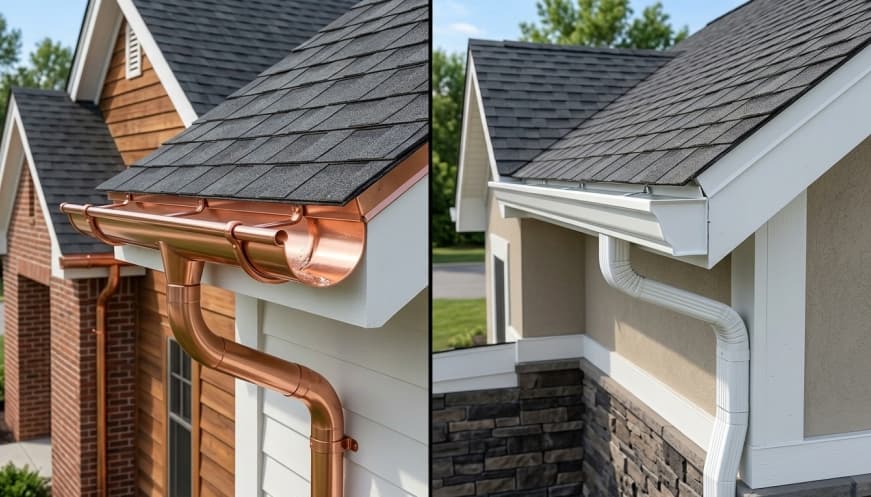
Half-Round and K-Style Gutters: Features Compared
| Factor | Half Round | K Style |
|---|---|---|
| Water capacity at 5 inch width | Lower, curved trough holds less volume | About 10.2 gallons per minute at standard slope |
| Installed cost (aluminum) | Generally 15 to 25 percent higher than K style for the same run | About $7 to $13 per linear foot |
| Mounting hardware | Round hangers, brackets, or straps | Hidden hangers that screw into the fascia |
| Cleaning | Smooth interior, fewer debris pockets | Flat bottom and corners can trap leaves and grit |
| Gutter guard options | Fewer, profile specific guards | Widest selection since most guards are built for this shape |
| Best fit | Historic, colonial, craftsman, and custom homes | Modern, ranch, and mid century homes |
| Common materials | Copper, aluminum, galvanized steel | Aluminum, galvanized steel, vinyl, copper |
Read Also: How to Clean Shingle Granules from Gutters
How Much Water Each Profile Holds
K style beats half round on raw capacity at the same nominal width. A 5 inch K style gutter carries approximately 10.2 gallons per minute at a 1/16 inch per foot slope, and a 6 inch K style carries about 19.6 gallons per minute at the same slope.
The reason comes down to shape. K style has a flat bottom and angled sides, which creates a larger cross sectional area than a curved half round trough of the same width.
A half round system can still handle the same rainfall load as a K style system, but it usually needs to go up one size, from 5 inch to 6 inch, or gain an extra downspout to keep pace.
This matters most on roofs over 1,500 square feet or in regions with intense, short bursts of rain. Contractors size gutters using local rainfall intensity data (NOAA Atlas 14) alongside the roof’s drainage area, not the profile shape alone.
If you already know your roof needs a high capacity system, ask your installer to run the numbers for both profiles before you pick based on looks.
Installed Cost for Each Gutter Type
K style usually costs less to buy and install than half round in the same material. Full gutter systems range from about $3 to $37 per linear foot for K style and $3 to $34 per linear foot for half round, with the wide range driven mostly by material choice rather than shape.
Material moves the price more than profile does. Aluminum installed averages $7 to $13 per linear foot, while copper runs $18 to $40 per linear foot installed.
A half round system in copper will always cost more than a K style system in aluminum, even though the profile itself only adds a modest premium once you compare like for like materials.
Labor plays a role too. K style can be formed on site in one continuous seamless run using standard equipment, which keeps installation time down.
Half round often needs specialized brackets, end caps, and outlets matched to its round shape, and copper half round is frequently soldered in sections rather than run seamless. That extra labor adds to the bill even before material cost is factored in.
Which Architecture Style Each Profile Suits
The house should decide the profile before the budget does. Half round has a smooth, semicircular look that matches colonial, craftsman, Tudor, and other pre 1950s architecture.
K style has a flat back and a decorative front edge that mimics crown molding, a look developed to match the trim details on mid century American houses.
Putting K style on a Victorian or a historic colonial can look out of place next to original trim and window details.
Putting half round on a plain modern ranch can look more ornamental than the house calls for. If you are restoring or preserving the original character of an older home, half round is the profile that reads as period correct.
If you are replacing gutters on a house built after 1950, K style is the profile most buyers and inspectors expect to see.
Cleaning and Clog Frequency
Half round is easier to keep clear because it has no flat corners where leaves and grit can settle. Water moves through the curved trough at a more consistent speed, which helps carry debris toward the downspout instead of letting it pile up.
K style’s flat bottom and angled sides create small dead zones in the corners where leaves, seed pods, and shingle grit collect.
Left alone, that buildup narrows the channel and slows drainage, which is part of why gutter guards are popular on K style systems.
Neither profile eliminates cleaning entirely. Homes near mature trees still need gutters checked at least twice a year, in late spring and after leaf fall, regardless of profile.
Gutter guards can stretch that interval out, and K style has far more guard options on the market because most manufacturers design for its shape first.
Material Options and How Long They Last
Both profiles come in the same core materials, but lifespan and price shift depending on what you choose.
Vinyl runs about $3 to $7 per linear foot and lasts 10 to 15 years. Aluminum runs about $7 to $13 per linear foot installed and lasts around 25 years.
Galvanized steel runs $5 to $20 per linear foot and lasts 20 to 30 years. Copper runs $18 to $40 per linear foot and can last 50 years or more with proper maintenance.
Copper is where half round earns its reputation as a premium option. A soldered copper half round system develops a green patina over time and is the material most associated with high end restoration work.
Aluminum K style, on the other hand, is the default choice for standard residential replacement because it balances cost, weight, and paint options without the upkeep copper requires.
Matching the Profile to Your Roof and Region
Picking between half round and K style comes down to three checks: roof size, local rainfall, and house age.
Work through them in order below, since each one narrows the decision further than the last.
- Calculate your roof’s drainage area. Measure the horizontal footprint of each roof section that drains into a single gutter run. Larger areas need more capacity regardless of which profile you pick.
- Check your local rainfall intensity. Areas with frequent heavy downpours need the higher capacity K style offers at a given width, or a half round system sized one inch larger to match it.
- Confirm your home’s architectural period. If the house predates 1950 or has a historic designation, half round keeps the roofline consistent with the original design. Newer construction rarely has that constraint.
- Get quotes for both profiles in your preferred material. Full system pricing, including labor, downspouts, and accessories beyond the per foot gutter cost, will show whether the aesthetic upgrade to half round fits your budget.
If the math says you need maximum capacity and the house has no historic requirement, K style is the practical choice.
If the house calls for a specific period look and you are willing to upsize or add downspouts to match capacity, half round works just as well functionally.
Conclusion
There is no universal winner between half round and K style gutters. K style wins on cost and water capacity, which is why it dominates modern residential construction.
Half round wins on appearance for older homes and on ease of cleaning, at a higher price. Start with your roof’s drainage needs and your home’s architectural period, then choose the material that fits your budget.
Following this approach helps you choose a gutter system that delivers reliable performance while also complementing your home’s appearance.