House centipedes are long, fast-moving insects with 15 pairs of legs and yellowish-grey bodies. The species most commonly found indoors in North America and Europe is Scutigera coleoptrata. Adults grow to about 25 to 50 millimeters in length.
They come inside because your home offers three things the outdoors cannot always provide: warmth, shelter from weather, and food. Centipedes eat other small insects including silverfish, cockroaches, spiders, and ants. If those prey insects are living in your home, centipedes will follow them in.
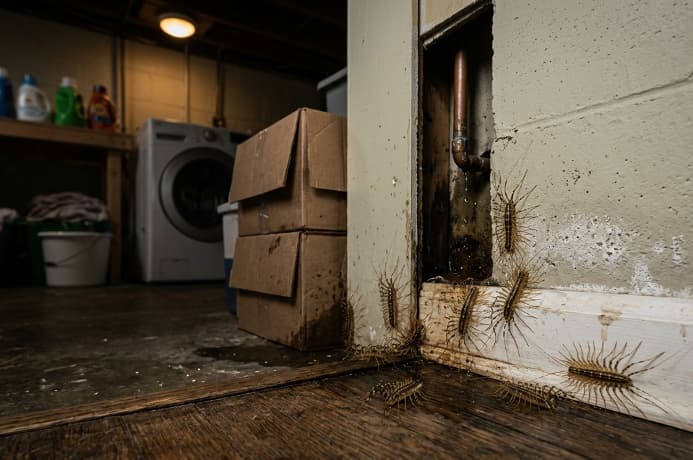
The sudden appearance of centipedes usually means something in your home environment recently changed. A new moisture source, an insect infestation, or seasonal cold driving them indoors are the three most common triggers.
Why Do I Suddenly Have Centipedes in My House: 8 Main Causes
Centipedes appear suddenly in homes because a specific condition has changed to make your house more appealing to them. The eight causes below cover the full range of reasons, from structural issues to seasonal patterns.
1. Excess Moisture Has Built Up in Your Home
Centipedes need moisture to survive. They lose water through their bodies rapidly and must stay in humid environments to avoid dying of dehydration. Any area in your home with high humidity becomes a target.
Basements, bathrooms, laundry rooms, and crawl spaces with poor ventilation are the most common moisture hotspots. A leaking pipe, a damp basement wall, or even a blocked drain can raise local humidity enough to attract centipedes within days.
2. A Sudden Increase in Small Insects Indoors
Centipedes do not eat plants, wood, or food scraps. They eat live insects. If you suddenly have centipedes, it often means you already have an insect problem you have not noticed yet.
Check for silverfish in bathrooms, ants in the kitchen, or cockroaches near warm appliances. A centipede infestation is frequently a symptom of a broader pest problem rather than a standalone issue.
3. Seasonal Weather Changes Driving Them Indoors
Centipedes move indoors in large numbers when outdoor temperatures drop in autumn and early winter. They cannot survive freezing temperatures, so they seek warmth inside homes, garages, and sheds.
This seasonal migration explains why many homeowners suddenly notice centipedes for the first time in October and November. The centipedes were living outside all summer and simply moved in when cold arrived.
4. Cracks and Gaps in Your Foundation or Walls
Centipedes enter through very small openings. A gap as narrow as 3 millimeters around a pipe, a crack in a foundation wall, or a poorly fitted door threshold is wide enough for a centipede to pass through.
If your home has an older foundation or recently had construction work, new gaps may have opened up. Inspect the base of exterior walls, around utility pipes, and along window frames for entry points.
5. Organic Debris Sitting Against Your Home’s Exterior
Mulch beds, leaf piles, and stacked firewood stored directly against your house give centipedes a warm, moist habitat right next to your walls. From there, moving inside takes very little effort.
Centipedes thrive in decaying organic matter because it attracts the small insects they feed on. Moving mulch and debris at least 30 centimeters away from your foundation cuts off this direct pathway indoors.
6. A Poorly Ventilated Crawl Space or Basement
Crawl spaces and basements with no vapor barrier and poor air circulation become extremely humid in winter. Relative humidity in unventilated crawl spaces can reach 80 to 90% in cold months, which is the exact environment centipedes prefer.
Read Also: How To Get Rid Of Pissants In The Kitchen?
If your centipede problem is concentrated in the basement or ground floor, the crawl space is almost certainly the source. Fixing the crawl space addresses the root cause rather than just managing symptoms.
7. Recent Heavy Rain or Flooding Near Your Property
Heavy rainfall saturates the soil around your home and drives ground-dwelling insects and arthropods to seek higher, drier ground. Centipedes follow the prey insects that flood out of the soil and end up moving indoors through any available gap.
This explains the sudden appearance of centipedes after a period of heavy rain, even if your home has had no moisture issues before. It is a weather-driven event rather than a structural problem.
8. Clutter Providing Shelter and Dark Hiding Spots
Centipedes are nocturnal and need dark, sheltered places to hide during the day. Piles of boxes, stacked newspaper, cluttered storage areas, and rarely moved furniture all create the conditions they need to stay and breed indoors.
Reducing clutter removes the hiding spots centipedes rely on. Without daytime shelter, centipedes cannot sustain a population inside your home over time.
How to Get Rid of Centipedes in Your House Fast?
To eliminate centipedes in your house, you need to remove moisture, seal entry points, and eliminate the insects they feed on. Treating only the centipedes without addressing these conditions means they will return. Follow these steps in order.
Step 1: Identify and fix all moisture sources. Check under sinks, around the base of the toilet, near the water heater, and along basement walls.
Repair any leaks immediately. Run a dehumidifier in the basement and bathrooms to keep relative humidity below 50%.
Step 2: Inspect and seal entry points. Walk around the outside of your home and look at every point where pipes, cables, or conduits enter the building.
Use caulk or expanding foam to seal gaps larger than 2 millimeters. Fit door sweeps on exterior doors where there is visible daylight under the threshold.
Step 3: Remove outdoor debris from against your walls. Clear all mulch, leaf litter, and stacked wood that sits within 30 centimeters of your foundation. Trim back any plants or shrubs that touch the exterior walls.
Step 4: Treat your home for the insects centipedes eat. Apply a residual insecticide spray along baseboards, under appliances, and in wall voids where ants, silverfish, or cockroaches may be hiding.
Reducing the food supply is the fastest way to make your home unattractive to centipedes.
Step 5: Apply a centipede deterrent around entry zones. Sprinkle diatomaceous earth (food-grade) along the base of walls, under appliances, and near drains.
Diatomaceous earth is a powder made from fossilized algae that damages the exoskeleton of insects and centipedes on contact without using chemical pesticides.
Step 6: Declutter storage areas and basement spaces. Remove boxes, old newspapers, and unused items from basement floors and storage rooms.
Vacuum corners, under shelves, and behind furniture to remove eggs and juveniles.
Step 7: Monitor for two to four weeks. Set sticky traps near walls and in corners to track centipede activity.
If numbers do not drop after two weeks, repeat the insecticide treatment or call a licensed pest control professional.
Are House Centipedes Dangerous to Humans or Pets
House centipedes are not dangerous to humans or pets in normal circumstances. They do have venom, which they use to paralyze small insects, but their jaws are too small and weak to break human skin in most cases.
On rare occasions, a centipede can bite if handled or trapped against the skin. The bite causes temporary pain and mild swelling, similar to a bee sting.
Symptoms clear within a few hours in most people. Allergic reactions are rare but possible.
Centipedes are not venomous enough to harm cats or dogs. A pet that eats a house centipede may experience mild mouth irritation but no serious effects.
The centipede you are most likely to find in your home, Scutigera coleoptrata, poses no meaningful health risk. Its presence is a nuisance problem rather than a safety one.
Where Do Centipedes Hide in a House During the Day
Centipedes hide in dark, damp areas during the day and come out at night to hunt. Knowing their hiding spots is essential for effective treatment.
| Location | Why They Hide There | How to Treat It |
|---|---|---|
| Bathroom drains and under sinks | High moisture and access to water | Fix leaks, apply drain covers, use diatomaceous earth |
| Basement walls and floor edges | Dark, cool, humid | Dehumidify, apply residual insecticide along walls |
| Crawl space | High humidity, lots of insects | Install vapor barrier, improve ventilation |
| Under appliances (fridge, washing machine) | Warmth and darkness | Pull out appliances and treat the floor area |
| Cardboard boxes and stored paper | Dark shelter near food sources | Replace boxes with sealed plastic containers |
| Wall voids near pipes | Warm and hidden | Seal pipe entry points, treat with foam insecticide |
How to Stop Centipedes from Coming Back After Treatment
Keeping centipedes out of your house long term requires ongoing maintenance rather than a one-time fix. The goal is to make your home consistently less attractive to them over time.
Maintain indoor humidity below 50% year-round using a dehumidifier or by improving ventilation. High humidity is the single most reliable predictor of centipede activity indoors.
Inspect your foundation and exterior walls every spring and autumn for new cracks or gaps. Silicone caulk and expanding foam degrade over time and need reapplying every two to three years.
Keep outdoor lighting away from entry points where possible. Exterior lights attract flying insects, which in turn attract centipedes. Switching to yellow-toned bulbs reduces insect attraction by up to 50% compared to white LED bulbs.
Store firewood at least 6 meters from the house, not against exterior walls. Keep gutters clean so water drains away from the foundation rather than pooling next to it.
How to Naturally Get Rid of Centipedes in the House Without Chemicals
Natural methods work well for mild or early centipede problems. They are slower than chemical treatments but safe for households with children and pets.
Diatomaceous earth is the most effective natural option. Spread a thin layer along baseboards, under appliances, and in crawl spaces.
It kills centipedes and their insect prey within 24 to 48 hours of contact.
Essential oils act as a short-term repellent. Peppermint oil, tea tree oil, and eucalyptus oil all deter centipedes when diluted with water and sprayed along entry points and baseboards. Reapply every three to five days for consistent results.
Sticky traps placed along walls and in corners catch centipedes overnight without chemicals. They also give you an accurate count of how many centipedes are active, which helps you judge whether the population is declining.
Reducing clutter and improving ventilation are natural fixes with no product cost. These changes work slowly but address the root cause rather than just catching centipedes one at a time.