Synthetic Underlayment and Peel and Stick Underlayment solve different problems on the same roof.
Synthetic is a mechanically fastened, water shedding layer that covers the open field of the roof deck at a lower cost.
Peel and stick, also called ice and water shield, is a self adhering, fully waterproof membrane required at eaves, valleys, and penetrations in many climates.
Most roofs installed today use both: synthetic across the field and peel and stick at the vulnerable spots where a small leak can do the most damage.
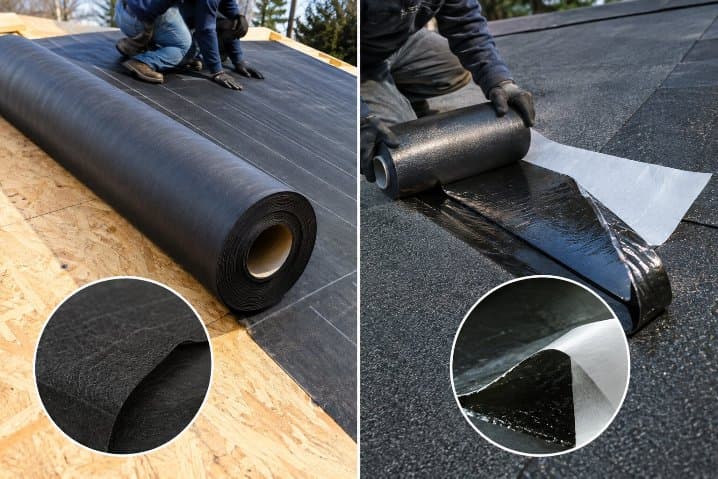
What is Synthetic Underlayment?
Synthetic Underlayment is a woven or non woven polymer sheet, usually polypropylene or polyethylene, that replaces traditional asphalt felt under shingles, metal, or tile. It is mechanically fastened to the roof deck with cap nails or staples, not glued down.
The material sheds water downslope the way a rain jacket sheds rain. It does not create a sealed, waterproof barrier, so it is not rated to handle standing water or the backup that forms behind an ice dam.
What it does offer is strength: synthetic underlayment resists tearing far better than felt, stays flat instead of wrinkling when it gets wet during construction, and provides better footing for installers walking the deck.
Common brand names include GAF Deck Armor, Owens Corning ProArmor, and IKO’s synthetic underlayment lines. Rolls typically cover 10 squares (1,000 square feet) per roll, which keeps labor time down compared to smaller felt rolls.
What is Peel and Stick Underlayment?
Peel and stick underlayment is a self adhering, rubberized asphalt membrane with a release liner on the back. Installers peel off the liner and press the sheet directly onto a clean, dry roof deck, so no fasteners are needed across most of the sheet.
The rubberized asphalt bonds to the deck and self seals around any nail or staple that later penetrates it, closing the hole as the fastener is driven.
Its self-sealing ability is what makes it truly waterproof rather than simply water resistant. That is also why building codes require it in areas most vulnerable to water backup, including eaves, valleys, and the areas around chimneys, skylights, and vent pipes.
Peel and stick is sold under names like GAF WeatherWatch, Grace Ice and Water Shield, and Owens Corning WeatherLock. High temperature versions exist for use under metal and tile roofing, where deck temperatures run higher than standard shingle installs.
Cost Comparison: Synthetic vs Peel and Stick Underlayment
Peel and stick costs two to four times more per square foot than synthetic underlayment, mainly because the rubberized asphalt, adhesive, and release liner add material and manufacturing cost that a plain woven polymer sheet does not carry.
On a typical 2,000 square foot roof, industry cost guides put the material cost gap between an all synthetic install and one that adds peel and stick at the eaves and valleys at roughly $1,000 to $1,400.
That gap covers only the vulnerable areas, not the whole roof, which is why full coverage peel and stick jobs run substantially higher.
Most roofing contractors avoid covering an entire roof in peel and stick unless the climate or roof design calls for it, such as a very low slope roof or a region with heavy, sustained ice damming.
For a standard pitched roof, synthetic in the field with peel and stick at the eaves, valleys, and penetrations keeps the water protection where it matters without paying premium pricing across the full deck.
Where Building Code Requires Peel and Stick
Many jurisdictions require peel and stick, referred to in code language as an ice barrier, at the eaves regardless of what underlayment covers the rest of the roof.
Section R905.1.2 of the International Residential Code states that in areas with a history of ice damming, an ice barrier consisting of a self adhering polymer modified bitumen sheet must extend from the lowest roof edge to a point at least 24 inches inside the exterior wall line.
This requirement applies to asphalt shingles, metal roof shingles, mineral surfaced roll roofing, slate, and wood shingles and shakes.
It is set by a jurisdiction’s climate history, not by roof pitch alone, so a homeowner in a cold climate region should confirm the local requirement before assuming synthetic underlayment alone will pass inspection.
Because code adoption and amendments vary by state and county, always confirm the current requirement with the local building department before finalizing a roofing plan.
Which One Should You Use?
Use synthetic underlayment across the main field of the roof and reserve peel and stick for the areas where water concentrates or code requires it: eaves, valleys, chimney and skylight penetrations, and any section with a slope below the minimum rating for standard shingle installation.
A few situations call for more peel and stick coverage than the minimum:
- Roofs in regions with heavy, sustained ice damming, where extending the eave barrier further upslope reduces the risk of backup under the shingles.
- Low slope sections (below roughly 4 in 12) where water drains slowly enough that a water shedding layer alone is not reliable.
- Metal or tile roofing installs, where a high temperature peel and stick product handles deck heat that standard synthetic or standard peel and stick cannot.
- Roof decks that will sit exposed to weather for an extended period during a phased construction project, since synthetic resists UV exposure better during that window.
Outside those cases, a synthetic field with code minimum peel and stick coverage gives most homeowners the protection they need without paying premium pricing for a full peel and stick roof.
Conclusion
Choosing between synthetic underlayment and peel and stick usually is not an either or decision.
Synthetic covers the roof field affordably and holds up well during construction, while peel and stick handles the spots where water actually causes damage: eaves, valleys, and penetrations.
Confirm what the local code requires, then budget for peel and stick where it is required or where the roof design calls for extra protection, and let synthetic cover the rest.