Yes, it can be a good idea if the roof is in sound condition and you can afford to replace it when its life ends. A flat roof is not a defect. It is a roof type that needs closer attention than a pitched roof because water leaves it slowly.
Four facts decide whether the purchase makes sense:
- The roof’s age tells you how much service life is left before the next replacement.
- The roof material sets the expected lifespan and the price of the next roof.
- Drainage shows whether water leaves the roof or sits on it.
- Insurability decides whether you can get coverage at a price you accept.
No roof is perfectly flat. Good practice is a minimum slope of 1/4 inch per foot so water runs toward the drains. A roof built without that slope is the first problem to look for.
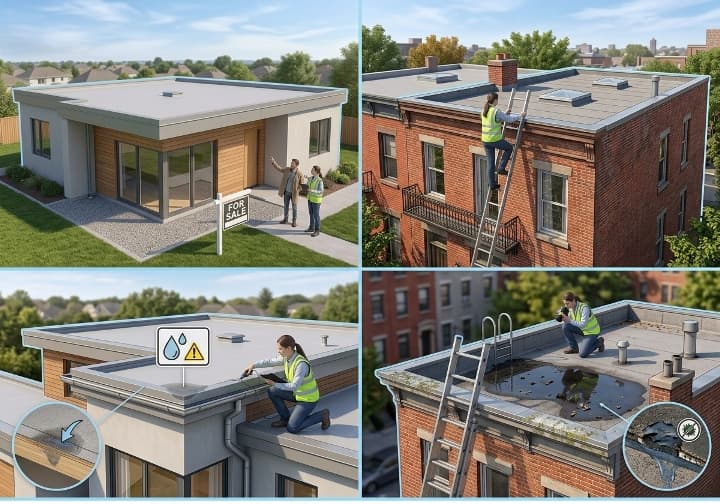
How Long Does a Flat Roof Last?
Most flat roofs last 15 to 30 years. Where a roof lands in that range depends on the material, the number of layers or the thickness, and the quality of the installation.
Think of roof age like mileage on a used car. It tells you how much life is probably left, not whether the roof is sound today.
The table below shows typical service life for common flat roof systems. A “ply” is one layer of roofing material. A “mil” is one thousandth of an inch of membrane thickness.
| Roof system | What it is | Typical service life |
|---|---|---|
| Built up roof (BUR), asphalt, 3 to 4 ply | Layers of asphalt and felt, often topped with gravel | 15 to 25 years |
| Built up roof, coal tar pitch, 4 to 5 ply | The same build with coal tar between the layers | 25 to 40 years |
| Modified bitumen, 2 ply | Asphalt blended with rubber or plastic so it stays flexible | 15 to 25 years |
| Modified bitumen, 3 ply | The same system with an extra layer | 20 to 30 years |
| EPDM, 60 mil, ballasted | A synthetic rubber sheet (ethylene propylene diene monomer) held down by stone or pavers | 20 to 30 years |
TPO (thermoplastic polyolefin) and PVC (polyvinyl chloride) are two other common membranes.
Both are sheets with heat welded seams, and their lifespan depends on thickness and installation. Ask the seller which system is on the roof, since each one is repaired differently.
A roof in its final years is not a reason to refuse the house. It is a reason to price the replacement into your offer.
How Much Does a Flat Roof Replacement Cost?
Plan on $4 to $14 per square foot for a flat roof replacement, with materials and labor included. A 1,200 square foot roof would cost roughly $4,800 to $16,800 at those rates. These figures are in US dollars and vary by region and contractor.
Material is the largest swing factor. Modified bitumen costs $6 to $13 per square foot, while metal costs $13 to $37. Labor alone runs $3 to $7 per square foot, and removing the old roof adds $1 to $5 per square foot.
For comparison, Angi puts the average cost of replacing a roof of any type at $9,500, with a range of $5,800 to $46,000. Flat roofs on small homes often fall at the lower end because the surface area is smaller and the work is simpler.
A written quote from a roofing contractor turns a vague worry into a number. You can use that number to ask the seller for a price reduction or a repair credit.
What is Ponding Water and Why Does it Matter?
Ponding is standing water that stays on a flat roof 24 to 48 hours after rain. The National Roofing Contractors Association (NRCA) uses that window to separate normal drying from a drainage problem. Water that sits longer points to poor slope, blocked drains, or a sagging roof deck.
Ponding matters for two reasons. It wears out the membrane, which is the waterproof surface layer, and it adds weight to the structure.
Water weighs about 5.2 pounds per square foot for every inch of depth. Three inches of water over 200 square feet adds roughly 3,120 pounds.
To check for ponding, look at the roof one or two days after rain. Look for puddles near low spots and drains. Look for dark stains or dirt rings that show where water sat earlier.
Also look inside the house. Stains on the top floor ceiling, bubbling paint, or a musty smell can mean water is already getting through.
Ask the seller whether the roof warranty excludes ponding damage. Some manufacturers refuse to cover roofs that hold standing water, so read the warranty terms before you rely on it.
Will a Flat Roof Raise Your Home Insurance Costs?
It can, mostly because of roof age and condition rather than the flat shape alone. Insurers look at age, material, and prior damage, and roofs over 20 years old may not be eligible for coverage. A roof that is old or in poor shape can mean a higher premium or a declined application.
Some carriers also change how roof claims are paid. A common option is an endorsement that pays wind and hail roof damage at actual cash value (ACV), mainly for older roofs that do not qualify for replacement cost. ACV means the payout is reduced by depreciation.
Here is a hypothetical example. A storm destroys a roof that costs $12,000 to replace. The insurer counts $7,000 of that as depreciation. You receive $5,000 minus your deductible and pay the rest yourself.
Before you make an offer, ask an insurance agent to quote the exact address. Give the agent the roof material and the year it was installed. Ask whether the policy pays roof claims at replacement cost or actual cash value.
What to Check Before You Make an Offer
Ask for the roof’s installation date, material, repair history, and warranty before you offer, then have a roofing contractor inspect it. A contractor can estimate how many years of service remain before replacement is needed.
Use this checklist in order:
- Ask the seller for the installation date and any invoices for the roof. Treat a roof with no records as near the end of its life until a contractor says otherwise.
- Request a copy of the roof warranty and confirm in writing whether it transfers to a new owner.
- Ask about past leaks and repairs, and who did the work.
- Hire a roofing contractor to walk the roof and look for blisters, splits, cracks, loose seams, and debris blocking the drains.
- Check that drains, scuppers, and gutters are clear. A scupper is an opening in the roof’s edge wall that lets water out.
- Get an insurance quote and a written replacement estimate before your inspection period ends.
Do not rely on a view from the ground. A roof can look fine from the yard and still hold water on the far side.
Buy, Negotiate, or Walk Away
Buy when the roof has documented age, drains within 48 hours, and carries a transferable warranty.
Negotiate when the roof is middle aged or near the end of its life. Walk away when you find ponding with soft spots or interior leaks and the seller will not adjust the price.
| What you find | What it means | Best move |
|---|---|---|
| Recent roof, records on hand, no ponding, transferable warranty | Low repair risk in the near term | Buy, and keep the records for your insurer |
| Middle aged roof, light wear, no ponding | Replacement likely within several years | Negotiate a lower price or a credit, and start a replacement fund |
| Roof near the end of its expected life | Replacement is close, and insurance may be harder to get | Get a contractor quote, then negotiate hard or walk away |
| Ponding, soft spots, or ceiling stains | The deck or insulation under the membrane may be wet or damaged | Walk away unless an inspection shows a limited repair and the price reflects it |
| Unknown roof age and no records | You cannot price the risk | Treat it as near the end of life until a contractor says otherwise |
Do Flat Roofs Have Any Advantages?
Yes. A flat roof gives you usable surface for equipment, a deck, or solar panels, and the surface is walkable, so inspections and maintenance are easier to do. Many buyers also like the modern look.
Solar is possible on a flat roof, but panels usually sit on raised, tilted mounts, which can add to the installation cost.
Ask any installer how the mounts attach to the membrane, because every hole in the roof is a possible leak point.
Conclusion
A flat roof should not stop you from buying a house, but it should change how you shop.
Learn the roof’s age and material, confirm that water drains within 24 to 48 hours, and read the warranty. Then get an insurance quote and a contractor’s written estimate.
If the numbers work, buy with confidence and set aside money for the day the roof needs replacing.
If the roof is old, undocumented, or holding water, use the estimate to negotiate or move on to another house.