Wet crawl space insulation is insulation that has absorbed moisture inside a crawl space. This happens when water enters the space through open vents, ground seepage, plumbing leaks, or high humidity. Once insulation gets wet, it stops working the way it should.
Most homes use fiberglass batt insulation in crawl spaces. Fiberglass is filled with tiny air pockets that trap heat.
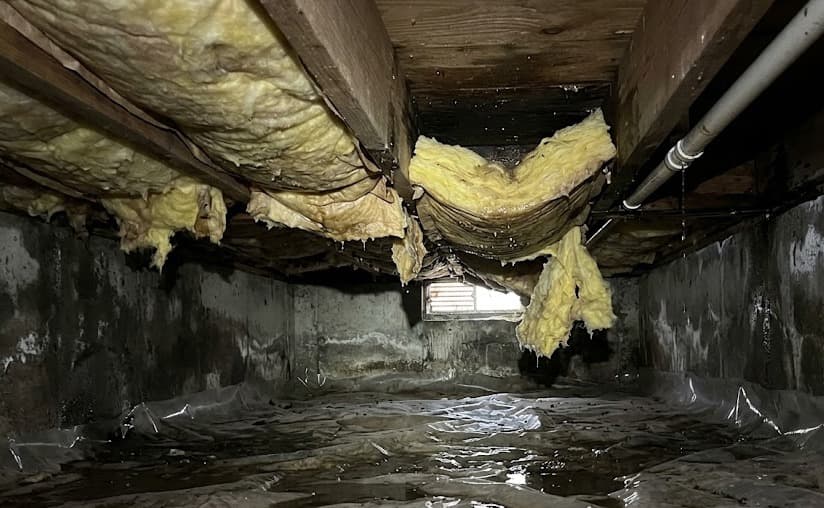
When those pockets fill with water, the insulation loses its ability to block heat transfer. A wet R-19 batt can perform as poorly as an R-6, or worse.
Why Wet Crawl Space Insulation is a Serious Problem
Wet insulation does more than lower your energy efficiency. It creates a chain of problems that can affect your health and your home’s structure.
Mold and mildew growth. Wet fiberglass is an ideal host for mold spores. Mold spreads to nearby wood joists and subfloor within 24 to 48 hours of contact with moisture. Once it takes hold, you face both a health risk and a costly removal job.
Wood rot and structural damage. Persistent moisture rots floor joists. Rotted joists weaken the subfloor above them. Over time, you may notice soft or bouncy spots in your floors.
Higher energy bills. Wet insulation transfers heat instead of blocking it. Your HVAC system works harder to maintain indoor temperatures, pushing up monthly energy costs.
Pest infestations. Damp insulation attracts termites, rodents, and other pests. These pests cause additional structural damage and make the problem much harder to fix.
Poor indoor air quality. Crawl spaces are connected to living areas through the stack effect. Air from the crawl space rises into your home, carrying mold spores and musty odors with it.
Main Causes of Wet Insulation in Crawl Space
Finding the root cause of the moisture problem is the first step to protecting your crawl space and insulation. Putting in new insulation without fixing the source is a waste of money.
Open or unsealed crawl space vents. Vents let in rain, snowmelt, and humid outdoor air. In humid climates, warm outdoor air meets cool crawl space surfaces and condenses into liquid water. This is a very common cause in the southeastern United States.
Ground moisture. Unencapsulated crawl spaces have exposed soil. Water from the ground evaporates upward and soaks into insulation. A vapor barrier stops this from happening.
Plumbing leaks. A slow drip from a pipe above the insulation soaks it over time. Homeowners often do not notice small leaks until mold or rot appears.
Poor drainage and flooding. If your property does not drain water away from the foundation, heavy rain pushes water into the crawl space. Clogged gutters and poor soil grading are common causes.
High humidity without ventilation. Even without standing water, high relative humidity causes condensation on cold surfaces, including pipes, joists, and insulation facings.
How to Tell If Your Crawl Space Insulation is Wet
You do not always need to go under the house to spot signs of wet insulation. These are the most common signals:
- Cold floors in winter, especially above the crawl space
- A musty smell coming through floor vents or registers
- Higher heating and cooling bills with no clear reason
- Visible mold on floor joists or subfloor when you do inspect
- Sagging or fallen insulation batts hanging from the floor joists
- Soft or springy spots in the floor above the crawl space
If you can access the crawl space, look for insulation that is discolored, compressed, or drooping. Wet fiberglass turns darker and often falls out of the joist bays entirely.
Should You Dry It or Replace Wet Crawl Space Insulation?
The answer depends on how much water the insulation absorbed and for how long.
Replace it if:
- The insulation is visibly sagging or has fallen to the floor
- There is mold on the insulation or on nearby wood
- The insulation has been wet for more than 48 hours
- You smell mold or mildew in the space
- The insulation is fiberglass (it is worth replacing with a moisture-resistant material regardless)
You may be able to dry it if:
- Only a small area got damp
- The insulation dried fully within 24 to 48 hours
- There is no mold and the insulation is not compressed or sagging
In most cases, replacement is the right call. Fiberglass does not return to its original R-value after getting wet, and it hides mold even when it looks dry on the outside.
Best Insulation for Wet or Damp Crawl Spaces
Not all insulation handles moisture the same way. These are the options ranked for crawl space conditions.
Rigid Foam Board Insulation (Best Overall)
Rigid foam board is the top recommendation from building scientists for crawl space use. It does not absorb water. It holds its R-value even in damp conditions. It also blocks air movement when properly sealed.
Rigid foam is installed against the foundation walls, not between the floor joists. This approach turns the crawl space into a conditioned space, which performs better than vented crawl spaces in most climates.
Two common types are XPS (extruded polystyrene) and EPS (expanded polystyrene). XPS has a slightly higher moisture resistance, while EPS costs less per sheet.
R-value: R-3.8 to R-5 per inch Moisture resistance: Excellent. Does not absorb water. Best for: Foundation walls in encapsulated crawl spaces
Closed-Cell Spray Foam (Best for Rim Joists)
Closed-cell spray foam creates an airtight, waterproof seal. It is the best option for rim joists, which are the boards at the top of the foundation wall where air leaks are most common. It bonds directly to wood and concrete and does not sag over time.
The drawback is cost. Closed-cell spray foam runs $1 to $2 per board foot for material alone. Professional installation adds to that figure significantly.
R-value: R-6 to R-7 per inch Moisture resistance: Excellent. Acts as a vapor barrier. Best for: Rim joists and hard-to-reach sealing points
Rockwool (Mineral Wool)
Rockwool is made from spun stone. It does not absorb moisture the way fiberglass does, and it dries more readily when it gets damp. It also resists mold and pests better than fiberglass.
Rockwool costs more than fiberglass but handles damp conditions much better. It is a reasonable choice for floor joists in crawl spaces that have been properly waterproofed and encapsulated.
R-value: R-3.0 to R-3.3 per inch Moisture resistance: Good. Drains water instead of absorbing it. Best for: Floor joists after encapsulation is complete
Fiberglass Batt (Avoid in Crawl Spaces)
Fiberglass is cheap and widely available, but it is the wrong material for crawl spaces. It absorbs moisture, loses its R-value when wet, supports mold growth, and sags out of joist bays over time. Building scientists consistently recommend against using fiberglass in crawl spaces.
If your crawl space currently has fiberglass insulation, replacing it with a moisture-resistant option is worth the investment.
How to Fix Wet Crawl Space Insulation: Step by Step
Step 1: Find and Fix the Water Source
New insulation will fail just as fast as the old insulation if the water source is still active. Check for plumbing leaks, blocked gutters, and poor soil grading around the foundation. Make sure downspouts direct water at least 6 feet away from the house.
Step 2: Remove the Wet Insulation
Wet fiberglass must be bagged and disposed of. Wear an N95 respirator, gloves, and eye protection. If mold is present on the wood joists or subfloor, stop and contact a mold remediation contractor before going further.
Step 3: Dry Out the Crawl Space
Run a crawl space dehumidifier and fans until the relative humidity drops below 60 percent. Use a moisture meter to confirm that wood surfaces read below 19 percent moisture content before installing new insulation. This step can take several days.
Step 4: Install a Vapor Barrier
A 20-mil polyethylene vapor barrier on the ground stops moisture from rising out of the soil. Lap the barrier up the foundation walls at least 6 inches and seal seams with butyl tape. This is a non-negotiable step for any crawl space in a humid climate.
Step 5: Install Moisture-Resistant Insulation
Install rigid foam board against the foundation walls, or closed-cell spray foam on the rim joists. For floor joists, use Rockwool or rigid foam instead of fiberglass. Seal all edges and gaps with foam tape or canned spray foam.
Step 6: Add a Dehumidifier (If Needed)
In humid climates, a crawl space dehumidifier keeps relative humidity below 55 percent year-round. A properly sized unit for a standard crawl space costs $800 to $2,500 for equipment, plus $1,500 to $3,000 for professional installation.
Wet Crawl Space Insulation Replacement Cost
Costs vary based on crawl space size, insulation type, and whether mold remediation or encapsulation is needed.
| Service | Cost Range |
|---|---|
| Insulation removal only | $500 to $1,500 |
| Insulation replacement (800 sq ft) | $1,000 to $3,500 (Fixr, 2025) |
| Full encapsulation with insulation | $3,000 to $12,000 |
| Mold remediation | $500 to $4,000 (HomeGuide, 2026) |
| Dehumidifier installation | $1,500 to $3,000 (Angi, 2026) |
| Complete crawl space repair | $4,500 to $8,000 average (HomeAdvisor, 2025) |
Fiberglass replacement costs $3.00 to $5.50 per square foot including labor. Closed-cell spray foam runs $5.00 to $7.50 per square foot for a full crawl space job.
Getting two or three quotes from licensed contractors is the best way to find an accurate number for your specific situation.
FAQ
What happens if crawl space insulation gets wet?
Wet insulation loses most of its thermal resistance. Fiberglass, the most common crawl space material, can drop from R-19 to near R-6 when saturated. It also creates conditions where mold grows on nearby wood surfaces, which can spread to the subfloor and floor joists.
Can wet crawl space insulation dry out on its own?
It depends on the amount of water and airflow in the space. Small amounts of dampness may dry out within 24 to 48 hours with good ventilation. Heavily soaked fiberglass almost never fully dries and should be replaced. Even if it dries, compressed fiberglass does not return to its original R-value.
What is the best insulation for a crawl space that gets wet?
Rigid foam board insulation is the top choice. It does not absorb water and holds its R-value in damp conditions. Closed-cell spray foam is the best option specifically for rim joists. Both materials are far better suited to crawl spaces than fiberglass.
How do I know if my crawl space insulation needs to be replaced?
The main signs are cold floors above the crawl space, a musty smell in your home, sagging or fallen insulation batts, visible mold on wood surfaces, and rising energy bills. If you can inspect the space directly, wet or discolored insulation is a clear signal.
Do I need a vapor barrier if I add new crawl space insulation?
Yes, always. A vapor barrier on the ground surface stops moisture from rising out of the soil into the crawl space. Without it, even moisture-resistant insulation will eventually deal with condensation and ground water. A 20-mil polyethylene barrier is the standard recommendation.
Conclusion
Wet crawl space insulation is a fixable problem. Start by finding the water source. Then remove the damaged material, dry the space, and install a vapor barrier before any new insulation goes in. Swap fiberglass for rigid foam board or closed-cell spray foam so the problem does not repeat.
The sooner you act, the less it costs. Mold and wood rot get worse the longer they sit. A professional crawl space inspection is a good first step if you are not sure how bad the damage is.