Buying a house with oil heat means the home’s furnace or boiler burns heating oil, also called No. 2 fuel oil, instead of natural gas, propane, or electricity.
Oil is stored in a tank on the property and delivered by truck, usually every few weeks in winter.
Around 4.79 million U.S. households use heating oil as their primary fuel, and about 82 percent of them are concentrated in the Northeast.
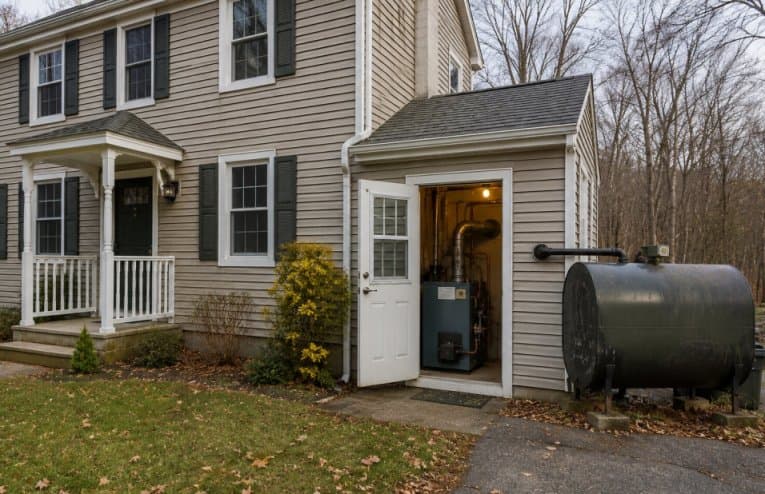
States like Connecticut, Massachusetts, Maine, New York, and New Hampshire have the largest share of oil-heated homes because many rural areas there were never connected to natural gas pipelines.
If you are house-hunting in one of these states, you will run into oil heat often enough that it is worth understanding the real costs and risks before you rule a home in or out.
Read This: Steps to Take When Considering a Fire-Damaged Home
How Much Does Oil Heat Actually Cost?
Oil heat costs about $1,390 to $2,046 a year for an average household, compared with roughly $679 to $750 a year for natural gas. The exact gap depends on your state, home size, and insulation quality.
The U.S. Energy Information Administration projected that homes primarily heated with oil would burn about 400 gallons over the 2025 to 2026 winter season, at an average price near $3.50 a gallon.
In Massachusetts, a typical oil-heated home spends more than $3,200 a year, while a cold-climate heat pump running the same home costs closer to $1,100 a year.
Oil prices are also unpredictable. As of mid-2026, heating oil futures were trading between $3.50 and $3.85 a gallon in the Northeast, and prices can jump 20 to 40 percent in a single cold snap when global crude markets spike.
That volatility is the main financial argument against oil heat: your winter fuel bill can swing hundreds of dollars year to year for reasons that have nothing to do with your house.
Oil Heat vs. Natural Gas vs. Heat Pump: A Side by Side Comparison
| Factor | Oil Heat | Natural Gas | Heat Pump |
|---|---|---|---|
| Average annual fuel cost | $1,700 to $2,046 | $679 to $750 | About $1,100 to $1,250 in cold climates |
| Price volatility | High, tied to global crude oil | Low to moderate, mostly domestic supply | Low, tied to local electric rates |
| Equipment lifespan | 15 to 25 years for a well-maintained furnace | 15 to 20 years | 15 to 20 years |
| Fuel delivery | Truck delivery, tank on property | Piped, no tank needed | No fuel delivery, runs on electricity |
| Upfront conversion cost from oil | Not applicable | $5,000 to $20,000 | $14,000 to $26,000 before incentives |
| Biggest property risk | Tank leaks and soil contamination | Gas line integrity, carbon monoxide | Minimal fuel-related property risk |
| Federal tax credit in 2026 | None | None | None. The Section 25C credit expired December 31, 2025 under the One Big Beautiful Bill Act |
The Oil Tank Is the Real Risk, Not the Furnace
A working oil furnace is not usually the problem. The tank is. Oil tanks, especially older underground ones, can corrode and leak fuel into the soil and groundwater.
Cleanup for a confirmed leak typically runs from $10,000 to well over $100,000 depending on how far the oil spread.
Here is what to check before you buy:
Tank age and location. Above-ground tanks installed in the last 10 to 15 years are the lowest-risk option. Underground tanks, particularly ones installed before 1990, carry the highest risk of undetected corrosion.
Tank documentation. Ask the seller for the tank’s installation date, any prior leak history, and the most recent inspection report. If none of that exists, treat the tank as unknown risk.
Insurance coverage. Many homeowner insurance policies exclude pollution and environmental cleanup, meaning a leak becomes an out of pocket expense for the homeowner. Ask your insurance agent directly whether oil tank leaks are covered before you close.
Environmental inspection. A soil test around the tank site, run by a certified environmental inspector, can catch a slow leak before it becomes a six-figure problem. This typically costs a few hundred dollars and is worth adding as a contingency in your purchase offer.
Check More: What you need to know If You’re Buying a House with a Septic Tank?
What It Costs to Convert Away From Oil Heat
If you would rather not deal with fuel deliveries and tank risk, converting to another heat source is an option, though not always a cheap one.
Oil to natural gas. This costs $5,000 to $20,000, with a national average around $8,500.
The price depends heavily on whether a gas main already runs to the property. If it does not, running a new line from the street can add $1,000 to $2,000 or more on top of the equipment cost.
Oil to a heat pump. A full heat pump installation averages $15,393 before incentives, with a typical range of $14,000 to $26,000.
Heat pumps deliver two to four units of heat for every unit of electricity they use, which is why operating costs are often lower than oil even though the upfront price is higher.
Payback period. Most oil to gas conversions pay for themselves in 6 to 10 years through fuel savings alone, though that window shrinks to 4 to 5 years when oil prices spike, as they did in 2022.
Heat pump payback depends more heavily on state rebates, since the federal 25C tax credit for heat pumps expired at the end of 2025.
If you plan to stay in the home for more than 5 to 7 years, a conversion is usually worth the upfront cost.
If you expect to sell sooner, the math often favors keeping the existing oil system and negotiating the tank risk into your offer instead.
Conclusion
An oil-heated house is not automatically a bad buy. The furnace itself is usually reliable for 15 to 25 years with routine maintenance, and in much of the Northeast, oil heat is simply the norm rather than a red flag.
What actually determines whether the home is worth buying is the tank: its age, its location, and whether it has ever leaked.
Get it inspected, confirm your insurance coverage, and budget for fuel costs that run higher and less predictable than gas.
Do that homework up front, and oil heat becomes one more line item in your decision, not a hidden liability waiting to surface after closing.