Your driveway is cracking because something underneath or around it is putting stress on a surface that cannot bend.
Concrete and asphalt are rigid materials. When the ground below shifts, water gets trapped, or weight presses down unevenly, the surface has nowhere to go except to split.
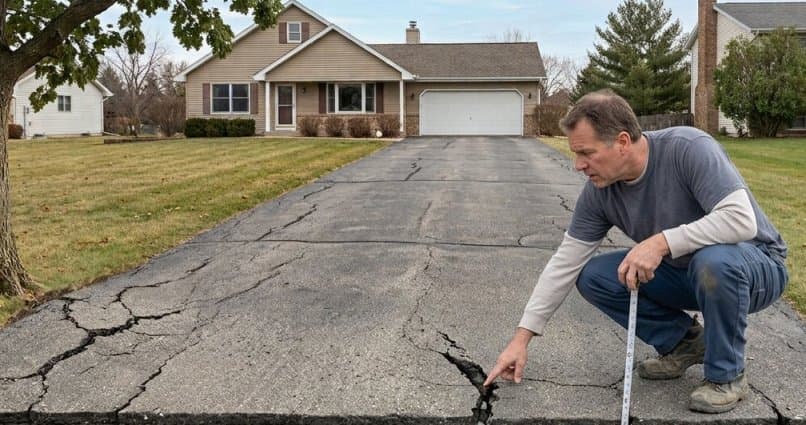
Five factors account for almost every driveway crack: soil movement, water intrusion, temperature swings, excess weight, and installation shortcuts. Most driveways that crack early show more than one of these problems at once.
How Soil Movement Cracks a Driveway
Soil movement cracks a driveway when the ground underneath settles, erodes, or shifts unevenly, leaving parts of the slab without support. Once a section loses its base, gravity and traffic do the rest.
Clay soil is a common culprit. It shrinks during dry spells and swells when it absorbs rain, and that cycle pushes the driveway up and down across the seasons.
Tree roots cause a similar problem. As roots grow toward the moisture and space under a driveway, they lift the slab from below and crack it along the path of least resistance.
Erosion is the third soil related cause. Water flowing downhill under a sloped driveway slowly washes away the supporting soil, a process known as soil erosion, until the slab above is left hanging over empty space.
Read Also: Drawbacks of Sealing a Concrete Driveway
How Water and the Freeze Thaw Cycle Damage a Driveway
Water damages a driveway by seeping into small pores and existing cracks, then expanding when it freezes. That expansion happens because water increases in volume by roughly nine percent as it turns to ice, and concrete simply cannot absorb that added pressure without splitting further.
This freeze thaw cycle repeats every time the temperature crosses the freezing point, so a single winter in a cold climate can turn a hairline crack into a serious one.
Rock salt makes the problem worse, not better. Salt draws additional moisture into the surface, which gives the freeze thaw cycle more water to work with each time temperatures drop.
Poor drainage adds a second layer of water damage. If your driveway is flat, slopes toward your house, or sits near clogged gutters, water pools on the surface instead of running off. That standing water works its way underneath and erodes the base over time.
How Weather Swings Stress the Surface
Weather swings stress a driveway by making the material expand in heat and contract in cold, and that constant movement fatigues the surface over years of exposure.
Concrete and asphalt both react this way, though asphalt tends to soften more in direct summer heat.
Sudden temperature changes are more damaging than gradual ones. A slow seasonal shift gives the material time to adjust, while a sharp swing, such as a warm afternoon followed by an overnight freeze, concentrates stress in a short window and often produces a new crack right along an existing weak point.
How Excess Weight Causes Cracks
Excess weight causes cracks when a vehicle or object applies more pressure than the slab and its base were designed to hold.
Standard residential driveways are built for cars and light trucks, not delivery trucks, RVs, or construction equipment parked in one spot for days at a time.
Weight related cracks usually show up near the edges of the slab first, since edges have less support than the center.
Repeatedly parking in the same spot or turning sharply in one area concentrates that stress even further and speeds up cracking in that specific section.
How Poor Installation Leads to Early Cracking
Poor installation leads to early cracking when the base underneath the driveway is not compacted properly or the concrete mix itself is flawed.
A driveway is only as strong as the layer beneath it, and a thin or loosely packed base allows the slab to settle unevenly within the first few years.
Common installation mistakes include skipping reinforcement such as rebar or wire mesh, using too much or too little water in the concrete mix, and failing to place control joints where cracks can be safely redirected.
A driveway installed without these steps often needs repair well before its expected lifespan.
Driveway Crack Severity at a Glance
| Crack Type | Typical Width | Likely Cause | Action Needed |
|---|---|---|---|
| Hairline surface crack | Less than 1/8 inch | Normal curing or minor weather stress | Monitor, reseal during next scheduled sealing |
| Moderate crack | 1/8 inch to 1/4 inch | Freeze thaw cycle, minor soil movement | Fill with sealant or patching compound |
| Wide crack | 1/4 inch to 1/2 inch | Water infiltration, drainage issues | Professional patch, check drainage |
| Structural crack with sinking | Over 1/2 inch or uneven height | Soil erosion, poor base, tree roots | Professional evaluation, possible slab replacement |
A crack wider than a half inch is generally treated as a trip hazard and often needs the surface ground down or cut out and replaced.
Steps to Take When You Notice a New Crack
- Measure the crack width. Use a coin or a ruler. Anything under an eighth of an inch is usually cosmetic.
- Check for height differences. Run your hand across the crack. If one side sits higher than the other, soil movement or sinking is likely involved.
- Look at the location. Cracks near parked cars point to weight. Cracks near trees point to roots. Cracks near downspouts point to drainage.
- Clean the crack. Remove dirt and debris with a wire brush before any repair so sealant can bond properly.
- Fill small cracks promptly. A simple driveway crack filler kit costs about twenty to forty dollars and prevents water from entering during the next freeze thaw cycle.
- Call a professional for anything wider than a half inch. At that size, a proper fix usually means cutting out the damaged section rather than filling it.
- Reseal the whole driveway on schedule. Every five to ten years is the standard interval for both concrete and asphalt.
Conclusion
Your driveway’s integrity and look can be preserved for many years by being aware of the causes of driveway cracking and taking preventative action.
Whether addressing minor cracks or investing in a full replacement, timely action is essential to avoid costly repairs. By ensuring proper installation, regular maintenance, and appropriate usage, you can protect your driveway and enhance your property’s value.