Double pane windows have three surfaces that can get dirty: the outside face, the inside face, and the sealed air gap between the two panes of glass. Only the sealed gap requires special treatment.
If your window looks smudged or dusty on the surfaces you can touch, that is ordinary window grime and a normal glass cleaner handles it.
If you see haze, streaks, or water droplets that stay put no matter how much you wipe the glass, the moisture is trapped inside the sealed unit. That is not dirt. It is condensation caused by seal failure.
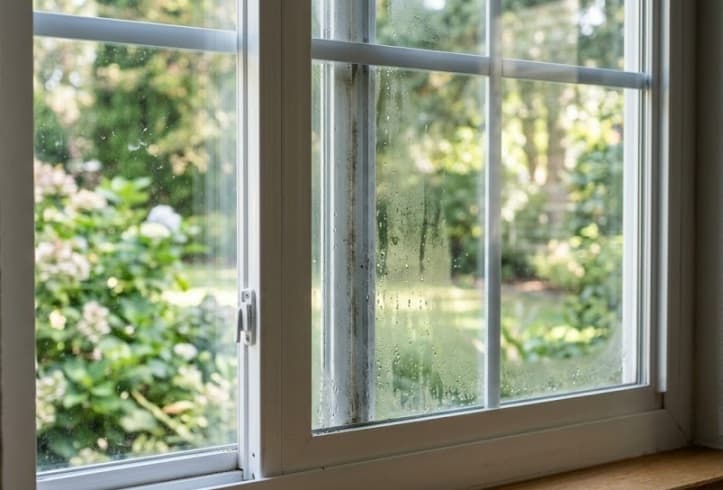
A double pane window is built from two panes separated by a spacer filled with a dry gas, usually argon, and sealed at the edges.
A desiccant strip inside the spacer absorbs stray moisture. Once the perimeter seal cracks from age, sun exposure, or frame movement, humid outside air replaces the dry gas, the desiccant becomes saturated, and condensation forms on the inside faces of both panes where you cannot reach it with a cloth.
Step 1: Confirm the Fog is Actually Between the Panes
Turn on a flashlight and hold it at an angle against the glass at night. Fog on the outer surface of either pane will move or clear when you wipe it.
Fog that stays no matter which side you clean, and that appears to sit in a thin layer sandwiched inside the glass, is between the panes.
Check the edges of the glass for a cloudy ring or visible cracking in the metal spacer bar. That is often the first place a seal gives out, since UV exposure and heat buildup weaken the sealant fastest on sun facing sides of the house.
Step 2: Decide Between Repair and Replacement
This decision comes down to cost, how long you want the fix to last, and whether you want to keep the window’s original energy performance.
| Option | Typical Cost | Restores Insulating Gas? | How Long It Lasts |
|---|---|---|---|
| DIY drill and flush kit | $60 to $200 | No | Cosmetic only; fog can return within months |
| Professional defog service | $75 to $200 | No | Cosmetic only; same limitation as DIY |
| Glass only (IGU) replacement | $150 to $600 per window | Yes | 15 to 25 years, same as new glass |
| Full window replacement | $350 to $2,500+ per window | Yes | 15 to 25 years for the glass; decades for the frame |
For most homes, IGU replacement is the better value. Roughly 85 percent of foggy window cases involve a sound frame with only the glass seal failed, which means swapping the glass unit restores full clarity and insulation at 65 to 75 percent less than a full window swap.
Read Also: Step-by-Step Guide on Removing Fake Snow from Windows
Step 3: If You Choose to Defog the Window Yourself
This method drains the trapped moisture through drilled vent holes. It is inexpensive, but it is permanent surgery on the glass and it will not put the argon gas back, so the window’s insulation value stays reduced afterward.
What you need: a carbide tipped glass drill bit, painter’s tape, safety glasses, gloves, a spray bottle of clean water, glass cleaner, a thin plastic tube, and clear silicone caulk.
- Mark two drilling points on the outer pane, one near the top corner and one diagonally opposite near the bottom corner.
- Cool the bit with water from the spray bottle as you drill slowly through the outer pane only. Stop once you feel the bit break through into the air gap.
- Let the space air out. Clearing time ranges from a few hours to a couple of weeks depending on humidity and how saturated the desiccant became.
- Once clear, flush the gap lightly with glass cleaner through the upper hole and let it drain and dry fully through the lower hole.
- Glue a short length of plastic tubing into the lower hole with silicone caulk to act as a permanent vent, then seal the upper hole once everything is dry.
Wear eye protection throughout. Glass dust and chips are common when the bit breaks through the second surface, and this process will not work on tempered glass without professional equipment.
Step 4: If You Choose Professional IGU Replacement
A glazier removes the failed glass unit from the sash, measures the opening, and installs a new sealed unit with fresh argon gas and matching Low E coating. Most jobs take under an hour per window and do not require removing siding or trim.
Ask the glazier three questions before booking: whether the frame and hardware are still in good condition, whether the glass carries a seal failure warranty from the original manufacturer, and whether your job qualifies for a multi window discount, since jobs with four or more windows often get a 15 to 25 percent per window reduction.
Step 5: Prevent It From Happening Again
Seal failure is largely a function of age, sun exposure, and moisture at the frame, so a few habits slow the clock on your remaining windows.
- Run bathroom and kitchen exhaust fans during and after showers or cooking to keep indoor humidity from stressing the seals.
- Check exterior caulk and weatherstripping once a year and reseal any gaps that let water pool against the frame.
- Avoid pressure washing directly at window edges, since forced water can accelerate seal breakdown over time.
- Keep an eye on south and west facing windows first. They take the most direct sun and fail sooner than shaded windows on the same house.
Conclusion
A cloudy double pane window is a sealed unit problem, not a cleaning problem. Wiping the glass will not help once moisture is trapped inside.
Drilling and flushing buys a cheap cosmetic fix, while swapping the insulated glass unit restores both clarity and insulation for a price that is usually far lower than replacing the whole window.
Match the fix to the actual condition of your frame and hardware, and keep an eye on south and west facing windows, since they tend to go first.